

I might regret this later, but here goes: I’m giving away a 3-month free trial of Fernsage to people who sign up for my writing meetup in December. If you have a draft you keep putting off, let’s hang out and write! I’ll offer my feedback on your draft if you want.

Have you gone to the gym lately?
When I set out to build Fernsage, I wanted an app to help me become wiser. Despite my years of experience as a marketer, writer, and founder, I felt I wasn’t retaining my knowledge. Nothing was compounding. I felt stupid. I thought perhaps what I had to do was to take more notes and revise my notes more often, which was how I did well in school. So I made a notes app that resurfaces an old note every day.
I used the app every day for about five months. I like the practice of commonplacing or hypomnēmata, where you revisit something you copied down previously. So, I made an app for that valuable practice and added all sorts of interesting automation that a physical notebook couldn’t do, like emailing you a note every morning. I genuinely thought it was a valuable product for others too. After putting it off for weeks, I finally plucked up the courage to share it in r/commonplacebook, where I had been sharing my commonplacing journey for months. It bombed, and I deleted my post about two hours later.
People hated me. They didn’t even dislike the product. I doubt they even went to the website. They just hated that yet another person (me) shared yet another app in their niche community.
But I was glad that happened. Without it, I might not have forced myself to look at Fernsage more honestly. That’s when I realized I was using Fernsage every day because I made it. Not because I found it useful. I fooled myself.
Oddly, I actually felt relieved. I could finally stop (subconsciously) pretending this thing that I made was great and move on to the next thing. But I wanted to answer a question first: Why hadn’t I found Fernsage to be valuable?
I found my answer in parenting.
Getting in the parenting reps
When my kids got HFMD and were home for 10 days, I practiced hypomnēmata to keep myself sane. I read Charlie Munger’s advice to avoid feeling sorry for myself. I read Clayton Christensen’s reminder to prioritize long-term stuff (like raising good children) over short-term gains (like working hard to get a raise). It was helpful to remind myself of all that when I was tired, grumpy, and couldn’t think straight.
But what I still had to do was to take action—or get in the reps. Whenever I started complaining that life was unfair and asking why it had to be my kids, I made myself pause and say in my head, “Complaining will only make me feel more miserable. Let’s try and find something good from this.” Of course, I found nothing good when I tried that for the first time. Nor the second time, nor the tenth time. It was only when I reflected back on the period that I noticed I was becoming more understanding and patient because I had to deal with meltdowns day in and day out.

No amount of reading, note taking, and revising my notes will make me a great parent if I don’t actually try to be one. I can read about being patient all day. I can read about how our time with our children is finite and we are always losing them. I can even write about that. But what I really need to do is to practice regulating my emotions and explaining myself calmly to my children whenever they melt down, over and over and over again. Yes, over and over and over again. Case in point: After writing What bedtime taught me about patience, I snapped at my son for stalling bedtime the following night.
Looking at how I parent made me realize why Fernsage as commonplace software wasn’t valuable to me. It wasn’t that I was forgetting my notes and needed an app to remind me. It was that what I have been working on cannot be learned from taking notes and reading alone.
Once or twice is not enough
Once that became clear to me, I started seeing the same pattern in other areas of my life, say, startups.
I have read and heard people talk about not overbuilding your MVP, especially when you have no customers yet. It feels so obvious until you are actually building it. Suddenly, everything feels non-negotiable and the scope creeps. I know it’s an MVP, but it really, really needs these 10 things.
No, it doesn’t.
This was first drilled into me when my former cofounder, SK, built the first version of Pebblely. It was just a Python script, a database to store images, and an interface for users to sign up, run that script, and see their images. I wasn’t sure about that minimum viable product because it was really minimal. But it worked. We hit our revenue target for the first month within the first day. As Pebblely gained traction, we gradually improved it. Many features that I thought were must-haves at launch were only nice-to-haves.

But it’s hard to internalize it from just a single experience. Overbuilding looks different for every product.
Despite that Pebblely experience, I overbuilt Fernsage before I had any customers. When using Claude Code (Opus 5.5) to build Fernsage, I noticed it kept wanting to build something comprehensive and thorough, even when it was unnecessary. For instance, it wanted to add multiple measures to prevent bad actors from creating Fernsage sites for spam. Nobody was even visiting Fernsage yet, let alone entering a credit card to publish a site. But because it felt easy to build the guardrails with Claude Code and they felt like the right things to have, I spent several days adding and checking them. I should have launched earlier.
I relearned the lesson the hard way by trying, failing, and then realizing I had learned this before. But that is the way.
I’m not stupid. I just haven’t practiced enough. I haven’t gotten in enough reps.
More than you think
That lesson made me realize that I need to do far more than I think is necessary: Practice being patient, build and launch more products, write more often.
Let’s take writing, for example. In September, I committed to publishing daily on my website. I have long wanted to be a writer, and I figured I wasn’t writing enough. I started writing a short article every day and thought it was sufficient because an article a day felt hard enough. Then I discovered Ryan Holiday has three to four months’ worth of daily articles ready to be published at any time. Mine were rookie numbers! I needed to write a lot more. Like A LOT MORE. Since then, I have written more daily and built up a buffer of three weeks of daily articles.
I caught up with SK last week, and he asked the hard question, as he always does: Has my writing actually improved?
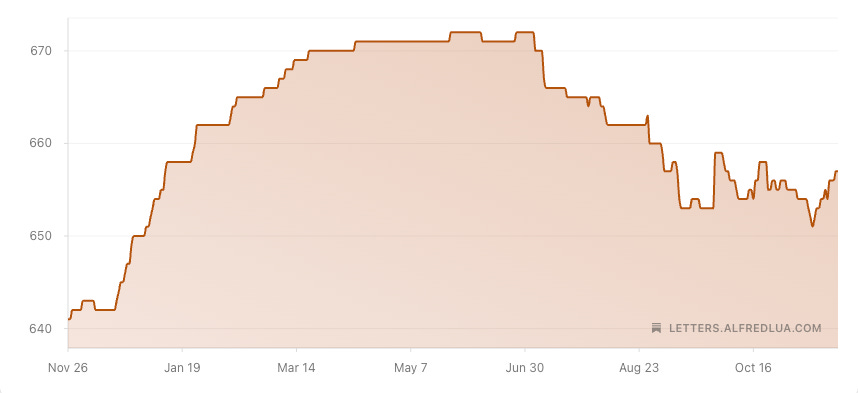
If we judge it by just the numbers, no. My subscriber list took a dip when I pivoted from marketing and AI content to parenting content and has been fluctuating at roughly the same 650 level. Apart from a few anomalies, most posts have rather low views.
But, very subjectively, writing has started to feel different. I have been noticing my bad habits more clearly as I write more regularly: I make generic claims like “people are building their own apps” without giving specific examples. I relay facts, not tell stories. I like to use “ultimately” to conclude. I write like I think, which is hard to read. And I don’t make my introductions interesting, transitions between sections smooth, or conclusions memorable.
Also, I have been thinking more about how I want to write. I tried copying Ryan Holiday’s format of sharing a quote or story in every daily article and also adding my personal stories. But they don’t feel as personal as I want them to be. I want people to read my writing and think, “Only Alfred could have written that!” I still have a long way to go, but the only way is through.
Along the way, I noticed a friend sitting with a pile of unfinished drafts. He kept telling me he wanted to write more, but he never did. It got me thinking: What if Fernsage could help aspiring writers get their reps in? I pretty much threw away the original version of Fernsage and figured out the smallest version that I could build to achieve that goal. The new Fernsage does one small thing: Help you get your writing reps in. You set a deadline for a draft, and Fernsage nudges you to write every morning with an email. You can also add a friend’s email address to get them to hold you accountable. (If that’s not enough, join Write Club!)
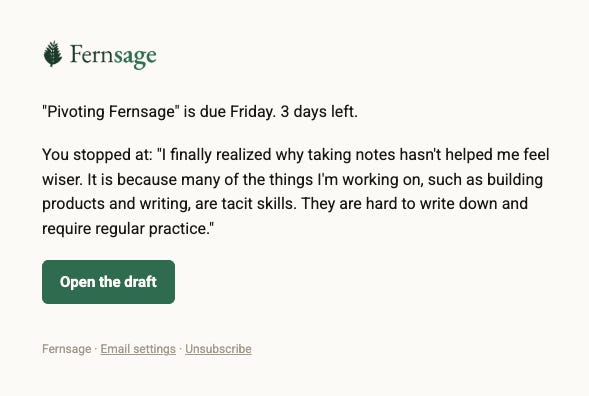
Honestly, I don’t know yet if this is what writers need. (If you keep putting off your drafts, try it for free and tell me whether it actually gets you to write!)
But I know I need to keep getting my reps in. Maybe this doesn’t work out. Then I’ll build another product. And another one. And another one.
This week’s daily posts
Day 76: You want well-read kids, but do you read?
C. S. Lewis, the famous author of The Chronicles of Narnia, loved to read from an early age. It is easy to see why. His parents were voracious readers who filled the house with books.
In Surprised by Joy, Lewis writes:
My father bought all the books he read and never got rid of any of them. There were books in the study, books in the drawing room, books in the cloakroom, books (two deep) in the great bookcase on the landing, books in a bedroom, books piled as high as my shoulder in the cistern attic, books of all kinds reflecting every transient stage of my parents’ interests.
As Lewis put it, finding a new book was as easy as finding a new blade of grass in a field. But isn’t that the case for all of us nowadays? Thanks to the internet, the Libby app, and local libraries, our children have access to a huge variety of books for free.
The question, though, is: do you read?
If we want our children to love reading, we have to love reading ourselves.
Inspired by Ryan Holiday, I read physical books so that my children can see me reading. I sometimes borrow books from Libby and read them on my Kobo eReader, which I think is fine because my son now recognizes a page of text. But I avoid reading on my phone in front of my children because I just look like I’m using my phone.
I also have books lying around the house, and I read to my children every night and whenever they ask. But what will actually make them want to read is seeing me read for pleasure in my own time.
Day 77: Edison bouncing back at 67
As a great fire was tearing through his factory, Thomas Edison told his son Charles, “Go get Mother and her friends over here. They’ll never see a fire like this again.” When Charles refused, he said, “It’s all right. We’ve just got rid of a lot of rubbish.” In fact, 13 of his buildings were on fire.
When the last open flames finally went out, an executive from the advertising department lamented that it was an awful catastrophe for Edison. Edison replied, “Yes, Maxwell, a big fortune has gone up in flames tonight, but isn’t it a beautiful sight?”
At the scene, he told reporters, “Am pretty well burned out—but tomorrow there will be some rapid mobilizing when I find out where I’m at.” The very next morning, he got his employees and a construction company into action to clean up the mess and rebuild the factory. By the end of the month, they resumed production of their trademarked Blue Amberol cylinders.
The fire cost Edison $919,788, with only about a third of it covered by insurance. He had to borrow $750,000 from his good friend, Henry Ford, to get his business back up again. But none of this deterred him. Even at 67 years old, Edison was fired up to start all over again. Most people of his age would have already retired.
In the face of disaster, Edison remained positive and acted quickly to get back on his feet. I can’t help but marvel at the example he set for his children. Every challenge we get in life is an opportunity to show our children how to deal with setbacks in their lives. Having watched his father start over at 67, Charles eventually became the president of Thomas A. Edison, Inc. and ran it for 30 years.
Day 78: Roald Dahl refused to accept the standard answer for his son
Roald Dahl was so frustrated with the problematic medical technology used to save his infant son’s life that he co-invented a better device.
On 5 December 1960, Dahl’s four-month-old son, Theo, was severely injured when a taxi crashed into his pram. His skull was shattered, and he suffered a traumatic brain injury. Surgeons had to insert a valve into his head to prevent a dangerous buildup of fluid in his brain. But the Holter shunts used back then were prone to clogging, and replacing them required repeated high-risk brain surgeries.
Roald brought together a hydraulic engineer friend and a pediatric neurosurgeon to create the Wade-Dahl-Till valve. By the time the device was ready, Theo had recovered enough that he no longer needed it. But the invention went on to help 3,000 to 4,000 children around the world.
Roald Dahl didn’t accept the standard answer for his son, even when it was given by an expert. I hope no parent and child ever has to go through what the Dahls did. But as parents, we often meet a smaller version of that. Society tells us to do this and follow that: Don’t send them to preschool before 3. Let them cry so they learn to soothe themselves. Don’t carry them too much, or they won’t learn to walk. Instead of simply accepting the norms, we should ask whether they fit our child and our lives. If not, we should push back.
My son often wants me to carry him. And I do. Yes, it’s tiring for me. Yes, he should learn to walk more. Yes, I often urge him to walk. But I recently realized he has grown so much that in a few months I probably won’t be able to carry him anymore. Will I carry him if he asks again in the meantime?
You bet!
Day 79: Wilma Rudolph’s belief in her mother
“My doctors told me I would never walk again. My mother told me I would. I believed my mother.” — Wilma Rudolph, the first American woman to win three gold medals in track and field in a single Olympics
Wilma Rudolph was born prematurely into a poor black family and couldn’t be cared for at the local hospital because of racial segregation. Her mother took care of her through multiple illnesses: measles, mumps, scarlet fever, chicken pox, double pneumonia, and polio. As if those weren’t bad enough, her left leg was becoming weak and deformed. The doctors told her mother she would never walk again.
But her mother refused to give up on her.
Twice a week for two years, Wilma’s mother took her on a bus to Meharry Hospital, a hospital 50 miles away. Gradually, she was able to walk with a metal leg brace. The doctors then taught her mother how to do physical therapy exercises at home. Finally, by age 12, she could walk normally. Just four years later, she went to her first Olympics and won a bronze medal. By the following Olympics, she won gold in the 100m dash, 200m dash, and 4x100m relay.
Wilma deserves most of the credit for beating the odds and winning the medals. But her mother’s stubbornness and determination made it possible. It’s not hard to imagine a parent simply accepting the doctors’ diagnosis (they are medically trained after all!) and living out the “prophecy.” We would never have heard of Wilma Rudolph in that case.
Instead, Wilma’s mother believed the diagnosis was wrong. She believed in Wilma. But more importantly, she acted on her conviction. Unlike the doctors Wilma saw at most a few hours a week, she was constantly with her supportive mother.
Her mother’s belief in her became her belief in herself.
That’s the impact we can make as parents. Our children will face plenty of naysayers in their lives. When I was in primary school, a teacher was so sure I couldn’t cope that she made the effort to tell me that every day. She wanted me to drop my Higher Chinese curriculum, even though my results were good enough for it. Thankfully, my parents supported my decision against the teacher’s “advice”. I eventually made my way to a top Chinese school, even though that teacher believed I would fail. (Sorry, there’s no way to avoid sounding arrogant to make that point.)
Have you quietly accepted something about your children when you should be believing in them instead?
Day 80: I thought I was thinking...
Remote work at Buffer was an amazing perk. But the best part was something I didn’t appreciate until later:
It forced me to write.
I don’t mean the articles I wrote as a marketer. I’m talking about the Slack messages, internal forum threads, and emails. Because I was one of the few who were working in APAC, I communicated with most of the company through text. Every day, I was practicing writing.
Back then, I often had ideas on how we should improve the product. I thought I had great suggestions because I was a marketer who was using Buffer regularly. If we had been an in-person company, I might have grabbed a product manager and rattled off my ideas.
Thankfully, we were remote, so I had to write my ideas down. When I drafted a post in our internal forum, I realized I hadn’t thought through my ideas well enough. As Paul Graham wrote, “Writing about something, even something you know well, usually shows you that you didn’t know it as well as you thought. Putting ideas into words is a severe test.” Composing my draft revealed many gaps in my ideas: Did I know whether marketers actually needed that feature, or did I extrapolate that from my own desires? What exactly was the problem that my feature suggestion was trying to solve? Could that problem be solved in other ways?
Leslie Lamport, the creator of LaTeX, puts it more bluntly:
If you’re thinking without writing, you only think you’re thinking.
I thought I was thinking. But I wasn’t.
I dropped some ideas when I discovered they were not well supported. Some of the ideas I eventually proposed did become a reality. But most importantly, those writing sessions taught me how to think like a product manager, the role I had wanted. I never became a product manager at Buffer, but I got to stand in when mine went on vacation.
So are you thinking?
Are you writing?
P.S. If you have always wanted to write but keep putting it off, join me for a writing session on Friday, 18 December, 10 am to 12 pm SGT (9 pm ET on the 17th). It’s a small group online: we’ll sit together, think, and write. It’s $20. To save a spot, email me at hello at alfredlua dot com.
Day 81: Are you wasting their childhood?
There’s a saying, “days are long, years are short.” We often look at our children and wonder where all those years went. We look away for only a moment, and they are all grown up.
But to paraphrase Seneca, it is not that childhood is short, but that we waste a lot of it. We have plenty of time for the greatest memories—if we invest it well. When we get distracted by meaningless activities, we only notice how much time has passed when they stop wanting to hang out with us. Their childhood isn’t short; we make it short.
When they are playing with their toys beside us, do we whip out our phones and scroll social media? Or do we get down on the floor and join in? When we have a long weekend ahead, do we wish the time would pass more quickly? Or do we slow down and enjoy having nowhere to be? When they stall bedtime, do we rush them to sleep so we can watch Netflix? Or do we lie beside them, knowing the number of bedtimes together is finite?
I don’t think we must give all our time to our children. I sometimes need time alone to recharge, so I can give them the best of me. But I try to be conscious of my choices: Am I paying attention or paying with their childhood?
Their time with us is long if we know how to use it.
If you want to get a post in your inbox every day, update your subscription settings here.